
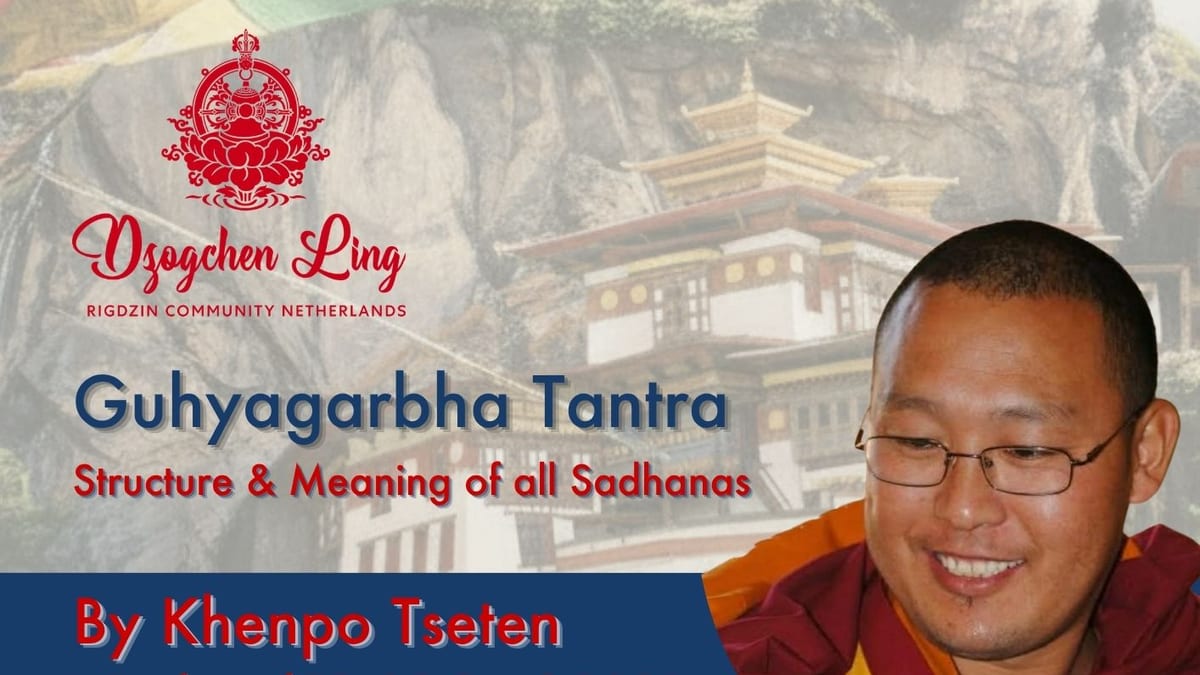
On Saturday 19 and Sunday 20 September 2026, Khenpo Tseten returns to Dzogchen Ling in Hoofddorp. He will give a weekend of teaching on the Guhyagarbha Tantra, using "Luminous Essence", the guide to this tantra written by Jamgön Mipham Rinpoche.
What is the Guhyagarbha Tantra?
Guhyagarbha means "secret essence", in Tibetan Sangwa Nyingpo. It is the principal text of mahayoga, the first of the three inner tantras in the Nyingma tradition. The other two are anuyoga and atiyoga, the latter better known as Dzogchen.
If you know the peaceful and wrathful deities from the Tibetan Book of the Dead, you already know a piece of this tantra: the mandala of the hundred peaceful and wrathful deities comes from it. In Nyingma monasteries the Guhyagarbha has for centuries been the foundation for the study of the tantras.
The structure behind every sadhana
On first acquaintance a sadhana looks like a long string of prayers, visualisations and mantras. Put a few sadhanas side by side and the same pattern keeps appearing: refuge and bodhicitta, dissolving ordinary appearance into emptiness, the deity and mandala arising, offerings and praise, recitation of the mantra, dissolving the visualisation again, and dedicating the merit.
That pattern is not arbitrary. It comes from the Guhyagarbha, and every step has a reason. Once you know those reasons, a sadhana stops being a text you get through and becomes a path with a beginning, a middle and an end. That goes for the Dudjom Tersar practices we do every week at Dzogchen Ling as well.
Mipham Rinpoche and "Luminous Essence"
Jamgön Mipham Rinpoche (1846-1912) was one of the great scholars of the Nyingma school. His overview of the Guhyagarbha, in Tibetan Ösel Nyingpo, walks through the whole tantra: what a mandala is, how the deities and their palace are laid out, and how the generation stage (kyerim) connects to the completion stage. It is available in English as Luminous Essence, translated by the Dharmachakra Translation Committee.
Khenpo Tseten
Khenpo Tseten studied at Shechen Monastery in Nepal, where he later led the monastic college under Shechen Rabjam Rinpoche. The title khenpo is only given after many years of study at such a college. Adzom Gyalse Rinpoche, who taught Trekchö with us in May, studied at the same college. Khenpo Tseten has taught at Dzogchen Ling before and has been teaching Western students in English for years. His biography is on the Teachers page.
Practical details
- Dates: Saturday 19 and Sunday 20 September 2026
- Times: 09:30 - 12:00 and 14:00 - 17:00
- Location: Dzogchen Ling Centre, Hoofdweg 727, Hoofddorp
- Offering: €120 for the whole weekend, €35 per half day
- Registration: info@rigdzin.nl
The teaching is open to beginners and seasoned practitioners alike. You are also welcome to attend single sessions.