Every Sunday at 11:00, Dzogchen Ling hosts a weekly group practice of Chö from the Dudjom Tersar tradition, at Hoofdweg 727 in Hoofddorp. Whether you know the practice well or want to connect with this lineage for the first time, you are welcome to join us.
What is Chö?
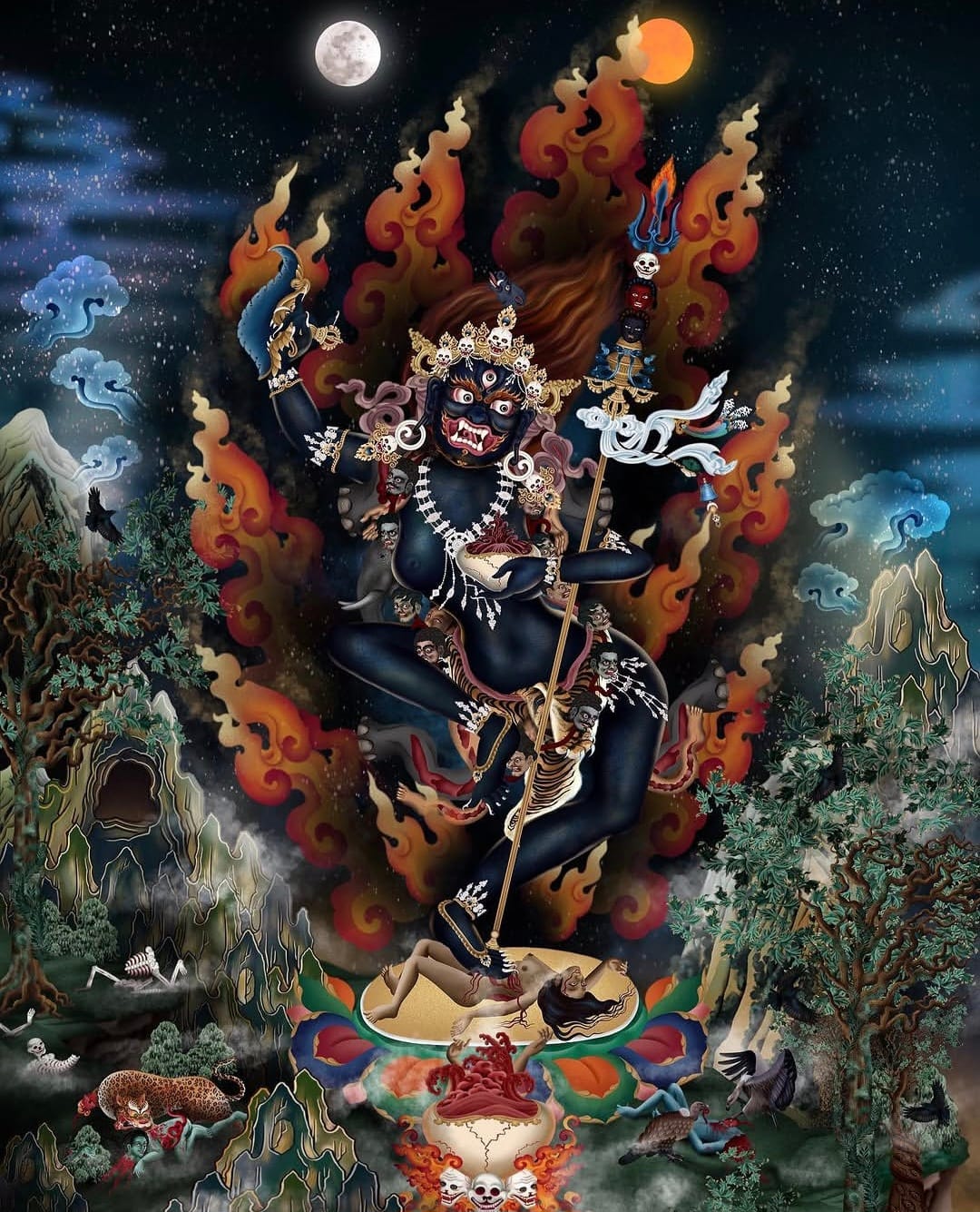
The Tibetan word Chö translates directly as "cutting through". It is a Vajrayana practice that severs the root of our suffering: ego-clinging and dualistic grasping. Rather than avoiding our fears, inner demons and obstacles, Chö teaches us to meet them and transform them through compassion and generosity.
What is cut is not the body, and it is not the demons from the stories either. It is the assumption that there is a self in need of protection.
Machig Labdrön
The practice goes back to Machig Labdrön, a Tibetan woman of the eleventh century. Her teaching is the only one that arose in Tibet and was then carried back to India, which was unheard of at the time. She brought together the emptiness teachings of the Prajñāpāramitā with an instruction so practical that you can start working with it straight away.
In imagination the practitioner calls up everything that is hungry: beings, forces, creditors from previous lives. Then he offers his own body, in pieces, holding nothing back. Generosity is carried through to the point where we would normally stop.
Classically, Chö is practised in places people would rather avoid: charnel grounds, crossroads, mountain passes at night. This is not theatre. Fear is the working material, and fear is hard to summon in a warm meditation hall.
The Dudjom Tersar and Dudjom Lingpa
Our practice follows the Dudjom Tersar, the "New Treasures of Dudjom". In the Tibetan tradition a terma is a hidden teaching concealed by past masters, meant to be discovered at the moment when it is most needed.
These termas were revealed by Dudjom Lingpa (1835 - 1904), a highly revered Tibetan meditation master and tertön (treasure revealer). Because these teachings were discovered relatively recently, they are said to carry a "warm breath": the transmission is fresh and direct, and speaks to the world we live in now.
Practising together with instruments
Chö engages body, speech and mind. During our Sunday sessions we practise as a group, chanting the Tibetan liturgy while playing the ritual instruments.
The Chö drum (damaru) and bell (drilbu) are played together to carry the rhythm of the chant, symbolising the indivisible union of skilful means and wisdom. The kangling, the thighbone trumpet, is blown to call on all beings, spirits and personal obstacles, inviting them to a feast of compassion, and to remind us of the impermanence of the body.
Practising these elements together creates a strong, resonant atmosphere. The collective sound of the chanting and the instruments cuts through ordinary conceptual thinking and supports the meditation and the shared energy in the group.
Coming for the first time
Everyone is welcome, including those with no experience of Chö. Let us know by email at info@rigdzin.nl if you are coming for the first time and we will make sure a text and instruments are ready for you. There is nothing else to bring, and the practice is learned mostly by doing it: the melody, the drum and the rhythm of the group show the way.
The Sunday practice sits alongside the weekly Ngöndro teaching on Saturday. Both are on the Programme page.